Texts
Here, excerpts from source texts are provided.
Oral history interview with Otto Piene
1988 Aug. 4 - 1990 Feb. 22, Smithsonian Archives of American Art (source)
Excerpt on stencil paintings, smoke drawings
ROBERT BROWN: Can you explain that briefly? I know that it's been written about as well, but could you—you came into that as early as the late 1950s.
OTTO PIENE: Right. What happened is that I did these stencil paintings, which led to the smoke drawings. The smoke drawings had to be treated with fixative. Fixative would collect on the surface and I somewhat impulsively burn off the accumulated fixative and that created the initial inspiration—for the fire paintings. I'm still working [00:32:00] with the same medium, meaning essentially, the fixative that I set on fire and mix with other, other combustibles that collect on the painting, and the painting gets thrown around, and moved around, which creates flow, and the flow becomes the forming, so to speak. And burning it off in a moment preserves the sense of, you know, instantaneous action and also preserves the sense of flow, because normally when you work with liquid mediums such as oil it takes a long time to dry—or watercolor takes still a very long time to dry, and much of the freshness of the organic change gets lost in that process of consolidation.
ROBERT BROWN: Whereas you freeze it literally.
OTTO PIENE: I kind of freeze it, meaning do the opposite. I burn it in an instant, and it gets preserved that way, which creates a neighborhood to organic form. I can't afford an organic form, so to speak, unlike Josef Albers, who couldn't afford it, see, because his, his paint took too long to dry. [They laugh.]
ROBERT BROWN: So this intensifies the experience, fixes it, and tries to keep permanently, that intensification.
OTTO PIENE: Yeah, it also makes painting a somewhat dramatic process, which is a little different from, from what it took to make stencil paintings, which was kind of opposite. Stencil paintings would still be a fairly quick process, once I had all the tools and all the preparations in place, but then it would take quite a while to dry, although the flowing really started there, because I would [00:34:00] flood the stencil painting with turpentine or, or whatever the solvents are, to make them more light-slick. So that kind of the flooding started then already, but then with the fire paintings, the flooding element would just burn off very quickly, and when I'm lucky, it all works well and I end up with an image. And if I'm not, then the whole thing burns up or just gets damaged and I have to start anew. But, you know, that's true with the regular painting process as well. Some paintings come out okay and others don't.
Otto Piene: Rasterbilder / Ceramics
By Tom McGlynn, ARTSEEN DEC/JAN 20–21
The exhibition Otto Piene: Rasterbilder / Ceramics was showcased at Sperone Westwater in New York from November 20, 2020, through January 16, 2021, with an accompanying review written by artist and critic Tom McGlynn for The Brooklyn Rail. (source)
Excerpt:
Another example of such an impression can be seen in Untitled (1957), a black-and-red Raster composition, with more of an oily than smoky trace, and Untitled (1957/67), a white-on-off-white accumulation of raised raster dots that appear to have been squeezed through a screen; this type of raised dot matrix is variously reprised in many of the ceramic pieces on view in the show. Piene’s search for alternative processes that might exemplify the artist as an enlightened alchemist is made clear by his focus on repetitive pattern, light, heat, and energy in these formative works. Recalling his wartime experience, he famously stated, “seeing is aiming”: the scansion of the grid as strategic mapping of the nighttime sky via searchlights, or as the fiery tracks of tracer bullet rounds, are translated into these works in a very direct way. Rather than presenting as evidentiary traumatic, these early raster paintings strive to incorporate and transcend the wartime technological towards an abstract phenomenology that might conceptually cauterize such painful manifestations of militarized empirical order, explosive heat, and light. Rather than redescribe the arc of historical tragedy in postwar German reflection more illustratively, as younger countrymen such as Jörg Immendorff or Anselm Kiefer would, Piene relied strongly upon the elemental substance of energy itself to propel his vision of a newer global dynamic.
Detail of Otto Piene ceramic at the Goldring-Piene Foundation
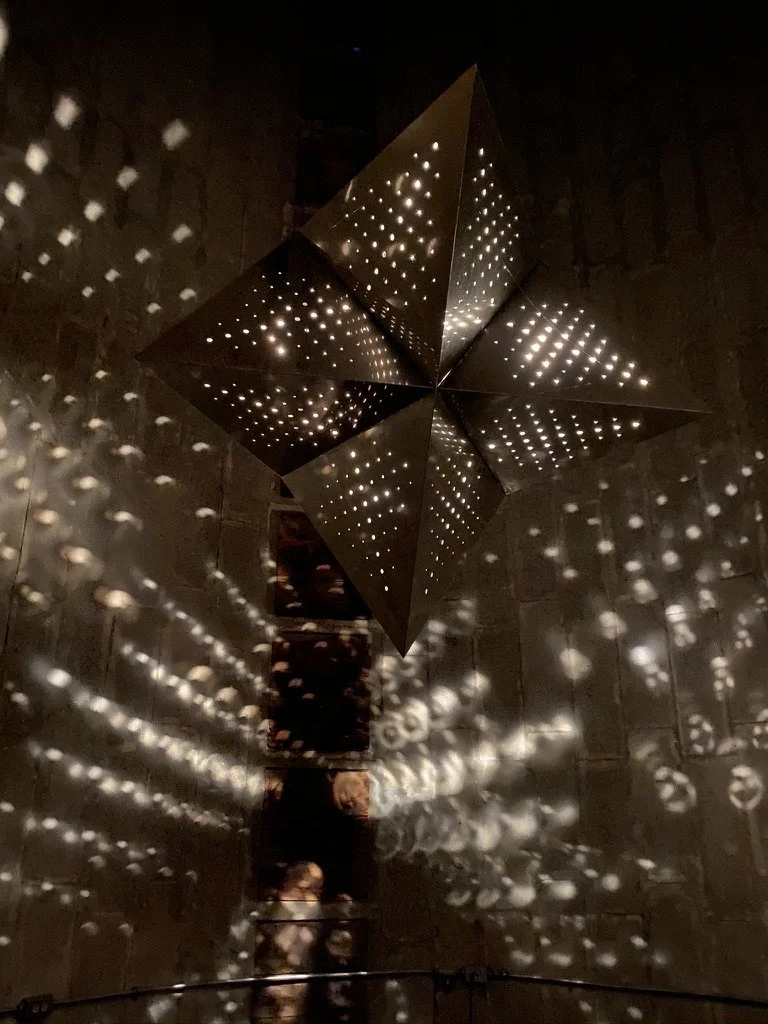
Light Silo
Otto Piene light ballet in the silo at the Goldring-Piene Foundation farm, October 9, 2020 (photo: Ellen Sebring)
Watch a video on Zero and light featuring Otto Piene and/or Listen to audio about the light ballet; from the exhibition ZERO: Countdown to Tomorrow, 1950s–60s, Guggenheim Museum, New York, October 10, 2014, to January 7, 2015.